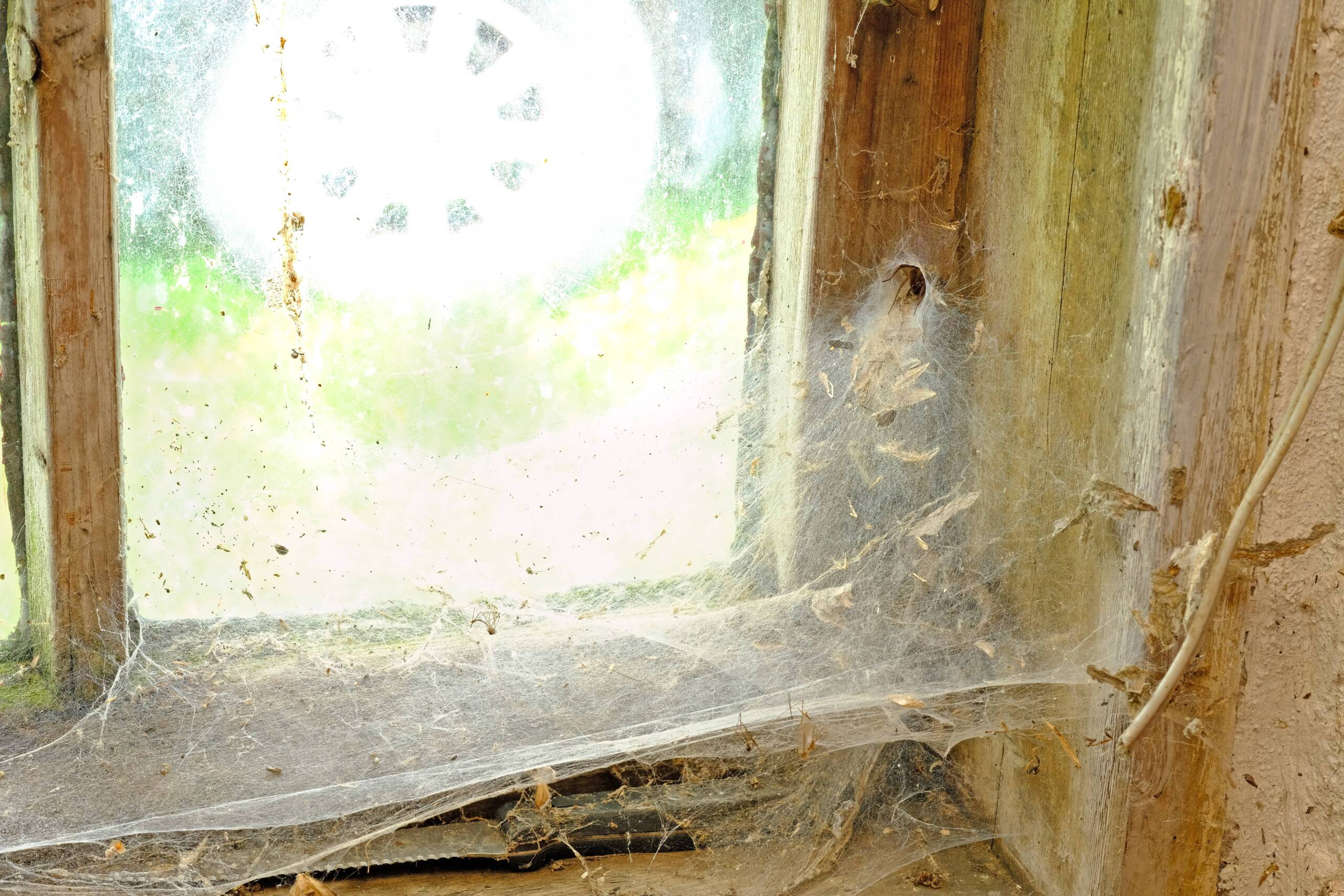
If there’s a big, round-bodied spider sitting in a perfect wheel-shaped web outside your window this fall, it’s almost certainly an orb weaver. They don’t hurt people, they don’t come inside, and they eat a lot of the flying bugs you don’t want around your house anyway. They build by windows because the light draws insects at night.
That’s the short answer. Here’s the longer one.
Every year, right about when the weather in St. Louis Missouri starts cooling off, we get the same calls. Someone walked out the front door and caught a web the size of a dinner plate across the face. Or there’s a spider as big as a quarter parked on the kitchen window and the kids won’t go near it. It’s spider season. And the spider behind most of those calls is the orb weaver.
What is an orb weaver spider?
Orb weavers are a large family of spiders (Araneidae) named for the round, spiral webs they spin. Picture any Halloween decoration you’ve ever seen. That web is an orb weaver web, which is a big part of why people call them Halloween spiders.
Around Missouri, these are the ones people usually notice:
- Yellow garden spider (Argiope aurantia). Black and bright yellow with long legs, and the one known for the zigzag down the middle of the web. Some people call it the writing spider.
- Banded garden spider. Close cousin of the yellow garden spider, with thin silver and yellow stripes across its body.
- Cross orb weaver and barn spider. Brown or tan with a very round, bulbous abdomen. They tend to hide in a corner during the day and sit in the center of the web at night.
- Spotted orb weaver. Another brown, round-bodied spider that often builds near porch lights and eaves.
What’s the zigzag “zipper” in the middle of the web?
That thick band of zigzag silk is called a stabilimentum. The garden spiders are the ones known for it.
Here’s the fun part: scientists still don’t fully agree on what it’s for. One idea is that it makes the web easy for birds to see, so they don’t fly through it and wreck it. Another is that it reflects UV light and pulls insects in. A third is that it helps hide the spider sitting behind it. It might be some mix of all of those. We like that a spider in your front yard is still a bit of a mystery.
Why do orb weavers show up in the fall?
They’ve been around all summer. You just didn’t notice them.
Orb weavers hatch in spring as tiny spiderlings and spend the whole summer eating and growing. By September and October, the females are full size and full of eggs, and their webs can stretch a couple of feet across. That’s when people start seeing them everywhere.
Shorter days make it worse. The sun sets earlier, so porch lights and indoor lights stay on for more hours every night, and that means more hours of bugs gathering at your windows.
It’s a short season, though. Most orb weavers die off after the first hard freeze, which around St. Louis Missouri usually comes in November. The egg sacs they leave behind make it through the winter, the babies hatch next spring, and the whole thing starts over.
Why do they build right next to my windows?
It comes down to light. A lit window or porch fixture at night draws in moths, gnats, and just about every other flying insect in the neighborhood. A spider that strings a web beside that light gets dinner delivered every evening. If you’re an orb weaver, it’s the best real estate on the block.
That’s why you see webs in the corners of your front windows and around the door light, and hardly any on the dark side of the house. It isn’t a sign that something is wrong with your home.
Are orb weaver spiders dangerous?
No. Like almost every spider, orb weavers have venom, but it’s meant for insects, not people. They aren’t aggressive. If you bump the web, most will drop to the ground or run to the edge rather than bite.
Bites are rare and usually only happen when someone grabs one or pins it against their skin. When a bite does happen, people usually describe it as milder than a bee sting: a little redness and swelling that’s gone in a day or two. If someone has an allergic reaction, treat it like any other sting and see a doctor.
Do orb weavers come inside the house?
Hardly ever. Orb weavers are built for open air, where they have room for a big web and a steady supply of flying bugs. The one on your window is on the outside of the glass and it’s staying there.
If you keep finding spiders inside, that’s usually a different kind of spider, and it’s worth having someone take a look.
Should I get rid of them?
Our honest take: if one isn’t in your way, leave it alone. Orb weavers catch a lot of mosquitoes, moths, and flies. That’s free pest control.
If one has set up across your front door or walkway, you don’t need to spray anything. Knock the web down with a broom, or scoop the spider into a cup and move it to a shrub along the side of the house. Many orb weavers take down and eat their old web and spin a new one each evening, so she’ll just start fresh somewhere else.
Spraying a web usually doesn’t do much anyway, since the spider rebuilds. It makes more sense to go after what’s drawing them in.
How to cut down on spiders around your windows
None of these need chemicals, and most take five minutes.
- Swap your outdoor bulbs to warm or yellow light. Insects are drawn most to white and bluish light. Yellow “bug light” bulbs or warm LEDs around 2700K or lower attract noticeably fewer of them, which gives spiders less reason to set up nearby.
- Put porch lights on a motion sensor or timer. A light that’s only on when someone’s walking up isn’t running a bug buffet all night.
- Close the blinds after dark. Light spilling out of a front window works just like a porch light.
- Brush webs down with a long-handled broom. It’s ongoing, but a spider that keeps losing her web will sometimes move on.
- Trim back shrubs and vines touching the house. Branches against the siding give spiders easy anchor points and places to hide during the day.
When it’s worth calling a pro
Most fall window spiders are harmless orb weavers. Give us a call at (314) 662-BUGS (2847) if:
- You’re finding spiders inside the house on a regular basis
- There are dozens of new webs in the eaves every morning, no matter how often you clear them
- You think you’ve seen a black widow or brown recluse around the house, garage, or woodpile
- You just don’t want to deal with it, which is a perfectly good reason
When there’s heavy spider and insect activity all around the outside of a home, a perimeter treatment around the foundation, eaves, and entry points cuts down on the bugs spiders feed on, and the spider numbers drop with it. exterior pest control
Mccarthy Pest handles spider and general pest control for homes in St. Louis Missouri, St. Charles, and St. Charles.
Orb weaver FAQ
Are orb weaver spiders poisonous?
Technically they’re venomous, not poisonous, and their venom isn’t a medical concern for healthy people. A bite, which is rare, feels about like a mild bee sting.
How big do orb weavers get?
The larger species, like the yellow garden spider, can reach about an inch in body length. With legs spread out, they can look two to three inches across. Males are much smaller.
Is a spider with a zigzag web dangerous?
No. The zigzag web belongs to garden spiders, which are a type of orb weaver. They’re harmless to people.
Do porch lights attract spiders?
Not directly. Porch lights attract flying insects, and spiders follow the insects. That’s why webs pile up around lights.
Do yellow bug lights really work?
Mostly, yes. They don’t stop every bug, but they attract far fewer insects than bright white or blue-toned bulbs, so fewer spiders build nearby.
Do spiders on my windows mean I have an infestation?
No. Orb weavers on the outside of your windows are normal in the fall. Spiders showing up indoors regularly is a different story.
When is spider season in St. Louis Missouri?
Orb weavers are most noticeable from late August through the first hard frost, usually around November.